Is there an alternative to austerity? Instead of posing that question the responsible political forces stick to austerity, though even after five years of crisis and “reforms” it has produced no growth but, instead, a deepening economic depression and historic high unemployment rates, a level – like that in Greece and Spain – not reached since the great depression in the 1930s.
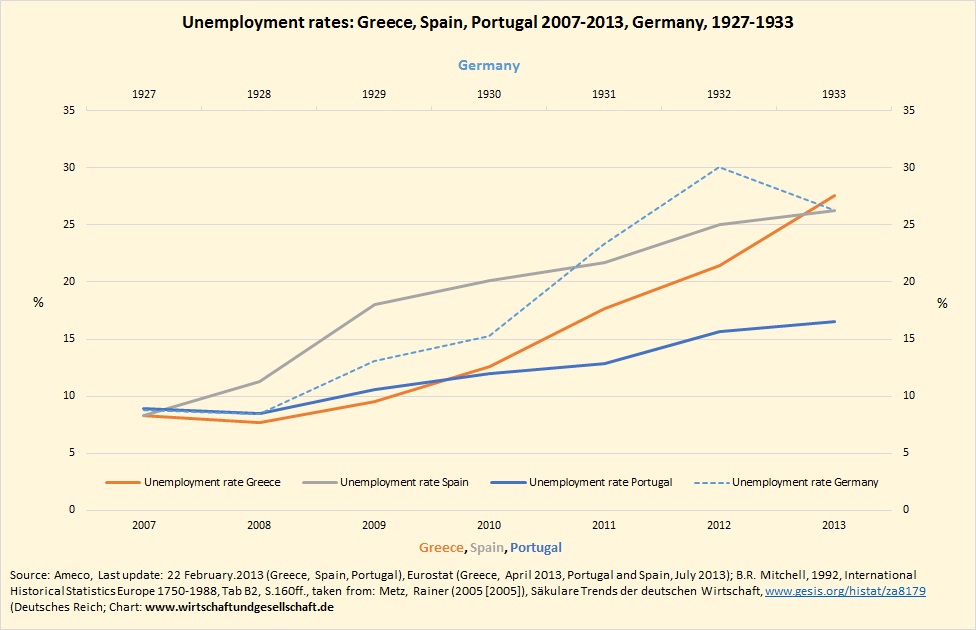
Click to enlarge chart.
Is this precarious political and intellectual state also an economical one? It is. Contrary to comparable historical situations – and practice – there is virtually no observable discussion in the upper ranks of political parties and decision-making bodies. A look into history discloses a rather different picture: classical as well as Keynesian economists were closely involved in political debates offering valuable advice applicable not only in their time but also for the present situation.
One of the most famous classical economists, David Ricardo, became a politician to press his economic and political ideas in parliament. When he published the third edition of his Principles in 1821 national debt had reached a historical high of round about 300 per cent of gross national product. It is not surprising, then, that the reduction of public debt had become a top political issue. Contrary to widespread opinion, Ricardo is not responsible for the at least among economists well known Ricardian equivalence (1). However, much more important is that Ricardo understood the problem of debt reduction as one of raising revenue above expenditure: “……no fund can be efficient for the reduction of debt but such as arises from an excess of revenue above expenditure.” (2) Ricardo developed different arguments and policy proposals to reach that goal. One of his proposals was to raise a capital tax of 25 percent (3). Comparing the controversial debate in his time with that today allows only one conclusion: We have fallen far behind that level.
Similarly in the 1930s, Michal Kalecki discussed the advantages of a capital tax to finance the cost of public debt or to completely avoid it (4). In a footnote of his Political aspects of full employment, in the edition of the Political Quarterly in 1943, Kalecki wrote: “Another problem of a more technical nature is that of the national debt. If full employment is maintained by government spending financed by borrowing, the national debt will continuously increase. This need not, however, involve any disturbances in output and employment, if interest on the debt is financed by an annual capital tax.” In his Theory of commodity, income and capital taxation (1937) Kalecki had already come to the conclusion: “Curiously enough, capital taxation not only make the gross profit rise by the total amount of this taxation, but also the income Cc+I (capitalist consumption and investment, T.H.), which remains to capitalists after they have paid the taxes, increases significantly…It follows from the above that capital taxation is perhaps the best way to stimulate business and reduce unemployment. It has all the merits of financing the State expenditure by borrowing, but is distinguished from borrowing by the advantage of the State not becoming indebted.”
Is there any lesson to learn from this in terms of the Euro crisis, and of Greece in particular? To ascertain this we should answer the following questions: How high are interest payments Greece´s government has to pay on its debt? How high is the tax burden and how high are capital taxes in Greece? Could it be possible to finance the interest payments by additional taxes? And could the necessary tax increase be financed by an additional capital tax? Finally, wouldn´t it be feasible and economically reasonable to leave this possible capital tax revenue to Greece for investment rather than interest payments, enabling Greece to foster growth and reduce its debt in the medium and long term by an excess of revenue above expenditure, as Ricardo put it, but not, as presently austerity tries, by cutting expenses, but by increasing revenue faster than expenditure. To avoid the loss of interest payments the creditors could alternatively agree with Greece to postpone the interest payments until that excess of revenue above expenditure has reached a stable level.
So far austerity has meant heavy losses of tax income because of its depressive impact on economic activity. This is shown in the chart below:

Click to enlarge chart.
In 2012 interest payments of Greece´s government amounted to five per cent of gross domestic product (GDP) round about ten billion Euro. For comparison, the average of the Euro area was three per cent of GDP, in Germany 2.5, in France 2.6 per cent.
The total tax burden in Greece (excluding imputed social contributions) is 80 per cent of current public revenue. The average of the Euro area is 88 per cent, in Germany it is 88.7, in France 87.4 per cent. If Greece would increase its tax burden to the average level of the Euro area revenue would increase by 6.5 billion Euro. This additional revenue would still be around three billion Euro less than interest payments.
How high is the revenue through capital taxes (6)? Capital taxes in Greece amount to 0.2 per cent of GDP. Measured by this method capital in Greece is even less taxed than in Germany which has with 0.4 per cent one of the lowest levels of capital taxes among the OECD countries. In average of the Euro area capital is taxed by 0.6 percent, in France by 0.9 per cent.
The difference between interest payments and revenue through capital taxes in Greece is 9.6 billion Euro. If Greece would decide to finance its interest payments solely through capital taxes, capital taxes therefore have to be increased by around ten billion Euro, respectively five per cent of GDP. All in all capital taxes then would amount to slightly above five per cent of GDP. This also seems quite high in comparison to the Euro area average or Germany and France. However, a sober assessment needs a deeper insight in the tax base and in the concentration and distribution of capital. The question then is, would a possible high concentration of private capital on the one side and the particular public financial distress as well as that of the economy as a whole on the other justify it?
Perhaps the answer is easier to affirm taking into account our proposal to spend this additional revenue not for interest payments but to invest it in full into the Greece economy making profits and income of those who payed the taxes rise again, too. Capital controls would probably be unavoidable as well as taking into account capital which has already been transferred abroad.
An additional ten billion in public expenditure or five per cent of GDP would inevitably bring about more growth and employment in the Greece economy, bringing back confidence, too, from abroad and domestically. As a consequence, higher growth would lift public revenue above public expenditure so that in the medium and long term, public debt will be reduced without harming any longer the people and economy of Greece. Beyond that, investment is the far more if not the only proper instrument to increase competitiveness in a sustainable manner rather than, as austerity policy tries, cutting wages and other expenditures.
—
(1) As the economic historian Carl-Ludwig Holtfrerich recently put it: “James Buchanan (1976) was wrong when he attributed the origin of Robert J. Barro´s idea of the equivalence of tax and debt financing to Ricardo in the latter´s seminal article Are Government Bonds Net Wealth? In fact, Ricardo was well aware that the public did not behave rationally under all circumstances. Its behavior, for example, would also be shaped by illusions of their private wealth from holding public debt. As to the equivalence of the tax burden of public debt and of fully redeeming it by a capital levy, Ricardo argued: ´If an individual is called upon to pay tax of 100 Pounds per annum instead of a sum of 2000 Pounds for once only, he will not make so great an effort to save, because he is seldom sensible that a tax of a 100 per annum is equivalent in value to 2000 Punds, – and therefore a system of loans is more destructive to the national capital than a system of heavy taxation to an equal amount.´ It is precisely this non-equivalence that Ricardo used to support his preference for tax-financing under all circumstances, even during wars, over debt-financing of government expenditure…” (Carl-Ludwig Holtfrerich, Government Debt in Economic Thought of the Long 19th Century, School of Business & Economics, Discussion Paper, Economics, 2013/4, Contributed to the symposium on “Government Debt in Democracies” in Berlin, 30 November and 1 December 2012)
(2) David Ricardo, Essay on the funding system (1820)
(3) “Ricardo put forward a concrete plan for carrying out a capital levy; a 25 per cent tax rate and a 5-year payment period”, writes Takuo Dome in his Political Economy of Public Finance, 1767-1873, referring to P. F. Asso and E. Barucci, Ricardo on the national debt and its redemption: some notes on an unpublished ricardian manuscript; Economic notes, 1988
(4) Michal Kalecki, Political Aspects of full employment, in the edition of the Political Quarterly in 1943.
(5) The complete footnote goes like this: “Another problem of a more technical nature is that of the national debt. If full employment is maintained by government spending financed by borrowing, the national debt will continuously increase. This need not, however, involve any disturbances in output and employment, if interest on the debt is financed by an annual capital tax. The current income, after payment of capital tax, of some capitalists will be lower and of some higher than if the national debt had not increased, but their aggregate income will remain unaltered and their aggregate consumption will not be likely to change significantly. Further, the inducement to invest in fixed capital is not affected by a capital tax because it is paid on any type of wealth. Whether an amount is held in cash or government securities or invested in building a factory, the same capital tax is paid on it and thus the comparative advantage is unchanged. And if investment is financed by loans it is clearly not affected by a capital tax because if does not mean an increase in wealth of the investing entrepreneur. Thus neither capitalist consumption nor investment is affected by the rise in the national debt if interest on it is financed by an annual capital tax.”
(6) “Capital taxes include (a) taxes on capital transfers like inheritance taxes, death taxes and taxes on gifts inter vivo, and (b) capital levies, which are occasional and exceptional levies on assets or net worth owned by institutional units. Examples for capital levies are betterment levies on the increase in the value of agricultural land due to planning permission to develop the land for commercial or residential purposes.” ()
Dieser Text ist mir etwas wert
|
|