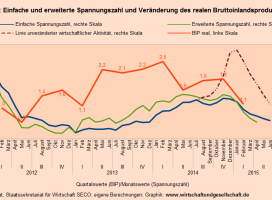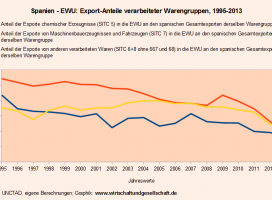
Heck, what´s going on there in the highest branches of macroeconomics? The distinguished Lawrence Summers presents a speech at an IMF conference talking about secular stagnation, pondering on the role of monetary policy, the role of interest rates concerning growth, the role of fiscal policy concerning growth and of, of course, since what is modern economics all about if not speculation. But on the biggest global player in this game who could also be named as biggest loser in this game Summers kept quiet. That´s why he is now the Summers of my discontent. I talk about wage-earners – for those many economists who forgot them after all those years of, well, let´s call it secular stagnation of neoliberal economics: that are those persons who go regularly to work, many of them experiencing a secular stagnation or even loss of compensation. There you are. After having cleared up this let´s pose the crucial question: What sense does it make to talk about nominal and real interest rates and all that stuff if you miss the biggest aggregate in macroeconomics? Take Germany for example. Compensation of employees in 2012 amounted to 1.4 trillion euro. In comparison: Gross fixed capital formation of the private sector amounted to 429 billion euro; gross fixed capital formation of general governemnt amounted to 41 billion euro. Here are the corresponding figures for the United States: 8.6 trillion, 2.7 trillion and 341 billion US-dollar.
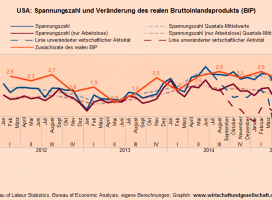
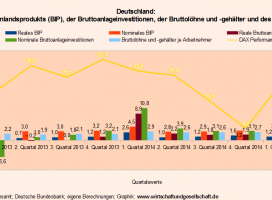
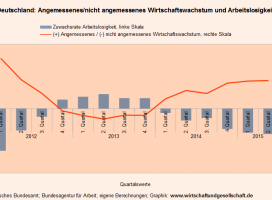
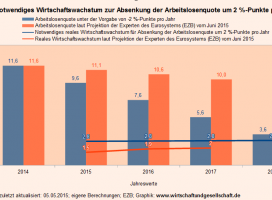
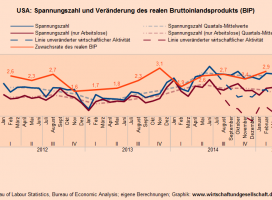
Moreover, if you look at the close correlation of wages and capital formation and of wages and private consumption you will perhaps agree that economic growth as well as economic crisis is well about wages and their development. Here is the development in the United States (we comprehensively analyzed it for Germany here) By the way: The development of compensation per employee signals that something went fundamentally wrong suppose also as far as income distribution is concerned not only in Germany but in the United States, too. Perhaps this alone partly solves the riddle of the private household debt problem in the United States whereas in Germany private households simply not consume more:

Click to enlarge chart.

Click to enlarge chart.
By doing so you could even overcome the frustrating result of Summer´s analysis which came out with the nonsensical sentence: “It is not over until it is over.” Son of a gun. Actually, while watching and listening to the speech of Summers I accidently thought it´s kind of Monty Python persiflage on the subject and subjects of economic “science” and its fictions.
But Summers is in good company. The distinguished Paul Krugmann promptly wrote not one but two columns celebrating Summers “forceful formulation” (here and here). Whooo! Well done. But Krugman misses wages as well. I mean in his analysis. For him slowing population growth matters, trade deficits and household debt, the latter at least relative to income. But he is far from focusing on the level, development and distribution of this very income. So far so bad. But even at the end of the darkest tunnel there is a light. Concerning the dark tunnel of macroeconomics the U.S. Department of the Treasury is holding the light. It is in its recent and brilliant analysis and critique of the German export surplus where they wrote, for example: “Private consumption, by far the largest component of domestic demand, could continue to be constrained as real disposable incomes remain under pressure from elevated unemployment, low real wage growth, and higher taxes. Meanwhile investment, which has made a significant contribution to weak domestic demand, is showing nascent signs of recovery but remains weak overall…The Netherlands and Germany have continued to run substantial current account surpluses since 2011, while the current accounts deficits of Italy and Spain and the smaller economies in the periphery have contracted significantly, primarily as a result of a collapse of domestic demand and falling wages.” Or according to Japan it sounds like this: “Sustaining growth in demand will depend on a rise in business investment, housing investment and especially growth in nominal wages.” There you are.
—
Wirtschaft und Gesellschaft – Analyse und Meinung (Economy and Society – Analysis and Opinion) has a as well and is happy if you “follow” or “like” us.
We would be happy, too, if you would like to financially support us through a one time gift or by voluntary subscription. You can do so by simply sending your contribution to:
Account holder: Florian Mahler
Banking house: INGDiBa
Bank Account Number: 5400653788
Bank Code Number: 500 105 17
Reason for Payment: wirtschaftundgesellschaft.de
Dieser Text ist mir etwas wert
|
|