
In his statement following his meeting with Mario Monti, Prime Minister of Italy, on the 13th of December, José Manuel Durão Barroso, President of the European Commission, was absolutely over the moon at the “encouraging signs that confidence has been returning in Italy’s capacity to solve its problems.” Barroso: “Let me praise Mario Monti and his government for this! Let me express my hope and confidence that Italy will continue on this path. This is a precondition for the country’s return to growth and jobs.” What has happend?
Barroso knows the answer: “Significant measures have been taken over the past year to bring down Italy’s excessive deficit and to tackle Italy’s high government debt. Considerable progress has been made to improve the country’s competitiveness and growth potential. One very important result that we can already see is regarding financing costs for Italy’s government bonds. In fact, the financing costs for Italy’s 10-year government bonds have reached their lowest level since 2010. This is directly linked to the credibility of the government of Italy and the measures taken.”
Barroso, however, forgot to mention, that not only the financing costs for Italy´s 10-year government bonds have reached their lowest level since 2010, but the growth of gross domestic product (GDP) has reached it, too. According to the European Statistical Office, Eurostat, real GDP growth will be down to -2,3 percent this year (2010: 1,8 %; 2011: 0,4 %).
Since the gap between nominal GDP growth and nominal long-term interest rates, i.e. 10-year government bonds, has even widened, nominal long-term interest rates being persistently above nominal GDP growth, government debt to GDP ratio has further increased. A smooth debt reduction can only work the other way around: if the nominal growth rate of GDP is pushed above nominal interest rates. The keen austerity measures, i.e. spending cuts, instead make GDP growth fall or even negative, because one man´s spending cut is another man´s income cut.
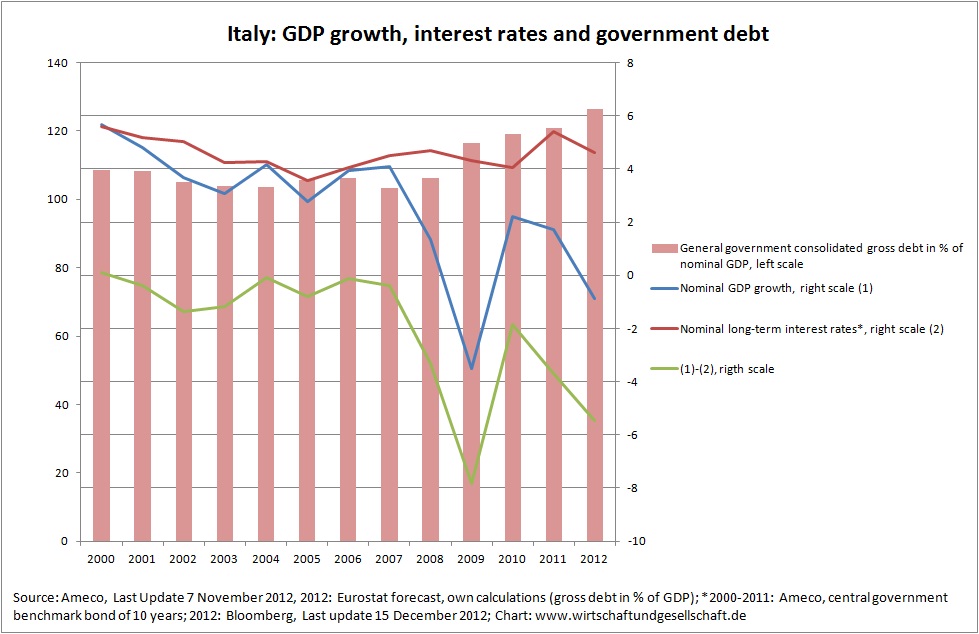
Italy: GDP growth, interest rates and government debt, 2000 - 2012 (click to enlarge chart)
The quarterly results show a similar picture to the yearly figures presented above.
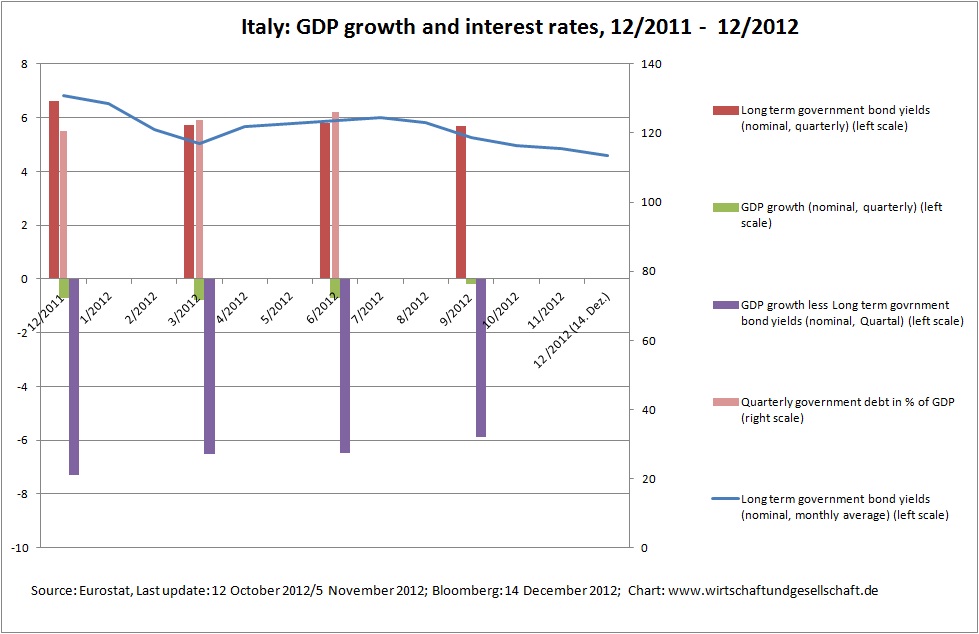
Italy: GDP growth, interest rates and government debt 12/2011 - 12/2012 (click to enlarge chart)
Against this background, Barroso is fundamentally wrong when he is seeing “encouraging signs that confidence has been returning in Italy’s capacity to solve its problems.” At the same time he is fully aware of what he calls the overall economic outlook, which has detoriated: “Implementation and determination are needed now, in particular as Italy’s overall economic outlook, in spite of all the good news I just mentioned, has deteriorated.”
That the overall economic outlook for Italy has detoriated is no reason for Barroso to rethink his strategy. The problem is: He is not alone, but represents the majority perspective at the top of the European Commission and, above all, of the German government.
And, of course, beeing a fundamentalist, he does not want to discuss alternatives: “There is no substitute for continued reform and consolidation at home. This is true for all countries and Italy is no exception.”
Finally Barroso ends with this somehow cynical remark: “I am confident that the difficult choices and in some cases the very important sacrifices of Italian citizens will pay off.”
So far, however, they haven´t paid off.
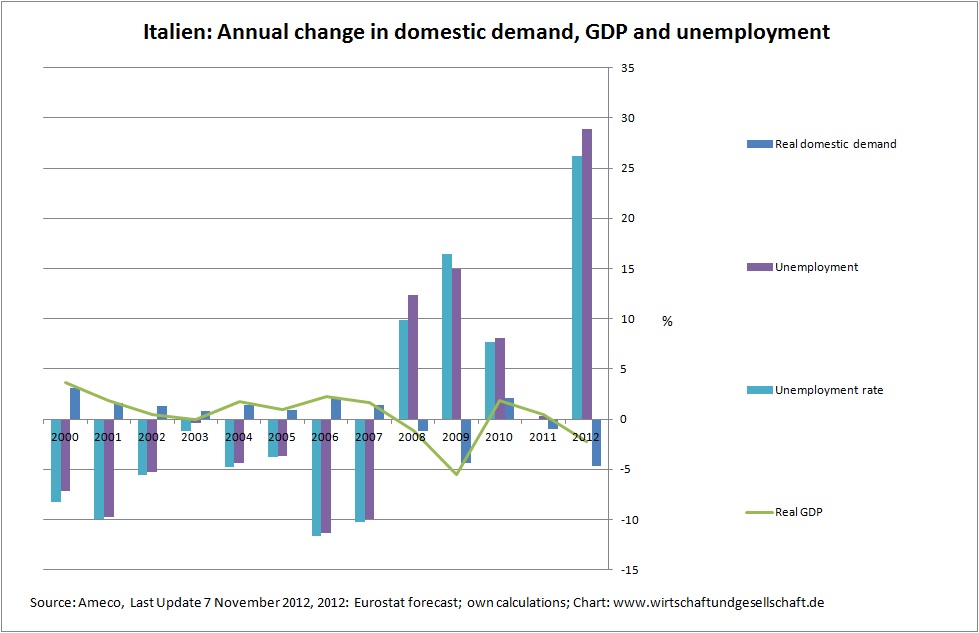
Italy: Annual change in domestic demand, GDP and unemployment (click to enlarge chart)
Imagine a “substitute for continued reform and consolidation” releasing Italian citizens from further sacrifices and bringing them employment and income by stimulating the economy via spending, not spending cuts.
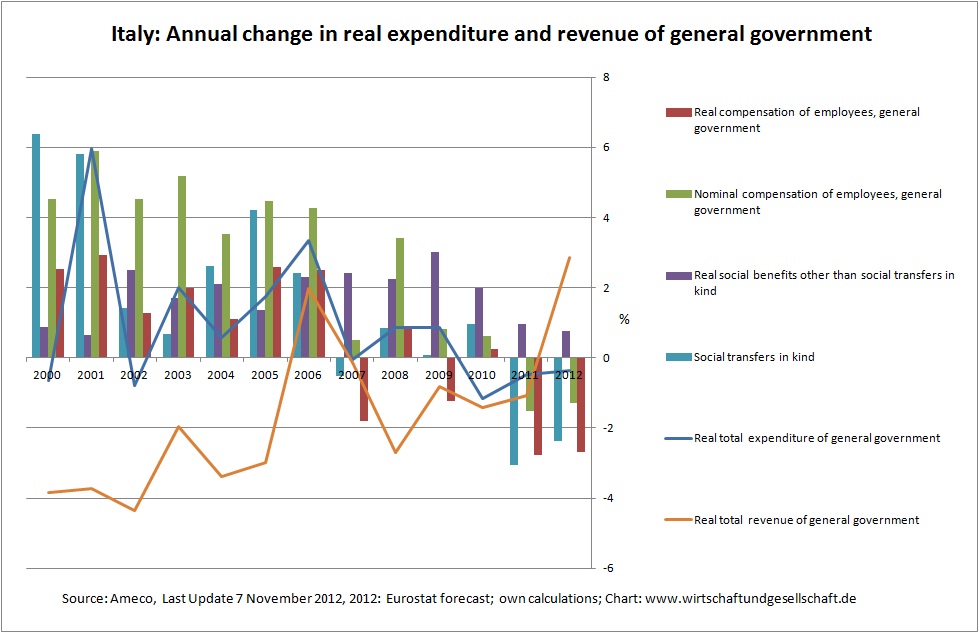
Italy: Annual change in government spending and revenue (click to enlarge chart)
—
Wirtschaft und Gesellschaft – Analyse und Meinung (Economy and Society – Analysis and Opinion) has a as well and is happy if you “follow” or “like” us.
We would be happy, too, if you would like to financially support us through a one time gift or by voluntary subscription. You can do so by simply sending your contribution to:
Account holder: Florian Mahler
Banking house: INGDiBa
Bank Account Number: 5400653788
Bank Code Number: 500 105 17
Reason for Payment: wirtschaftundgesellschaft.de
Dieser Text ist mir etwas wert
|
|



 Alltag im Regierungsviertel
